

AI in Manufacturing Revolutionizing Efficiency and Innovation
(Source: Rootstock article: “AI in Manufacturing: Revolutionizing Efficiency & Innovation”)
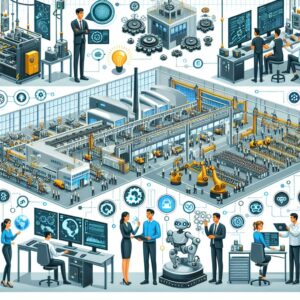
Manufacturers specifically are starting to realize how the different types of AI can be used in manufacturing. AI is already being used to automate processes and routine tasks, create more accurate forecasts, improve predictive maintenance, improve logistics, sniff out potential errors, and so much more.
Use Cases: AI in Manufacturing Examples
Predictive maintenance is a hot topic for how AI is used in manufacturing. Manufacturers typically spend much effort and money to optimize predictive maintenance schedules to minimize downtimes and maximize production efficiency and equipment utilization. AI can analyze real-time equipment data, weight it against past performance, repair and manufacturing costs, and delivery timelines, and generate optimal predictive maintenance schedules to maximize profits, efficiency, and more.
Quality control and defect detection
Quality control is based a lot on statistics, meaning there is an acceptable, albeit minimal, number of defects that make it through to customers. AI applications in manufacturing can analyze scrap, quality, customer, operations, equipment, and even visual data from cameras to monitor 100% of products and catch defects that a human might miss.
Supply chain optimization and demand forecasting
Optimizing the supply chain is an unrelenting and continuous effort for manufacturers, which makes it one of the most prominent AI use cases in manufacturing. Because AI works thousands of times faster and can analyze exponentially more data than any human ever could, it can capture data from suppliers, logistics providers, quality control, operations, sales, customer service, and more, all with just one goal in mind: getting products to customers efficiently.
Intelligent inventory management
Inventory is a critical yet expensive cost of doing business. Minimizing those costs while maximizing efficiency is a perfect example of the artificial intelligence use case in manufacturing. Imagine AI in ERP systems eliminating the need for manual inventory counts while ensuring always accurate information on quantities and locations
Benefits of AI in Manufacturing
The benefits of AI in manufacturing are many and the above examples are but a few. More broadly, AI in the manufacturing industry will change how every role interacts with technology and gains the time to focus on higher-value activities. Some specific benefits of AI and ML in manufacturing include the following:
1. Increased operational efficiency and productivity using more data in less time with higher accuracy to benefit the critical areas of manufacturing operations.
2. Improved product quality and reduced defects by working faster and more thoroughly than any human ever could.
3. Enhanced safety and risk management using data and intelligence to alert operations to potential issues, pull humans out of dangerous or tedious jobs, and serve as another pair of eyes constantly scanning for risks.
4. Cost savings through optimized resource utilization by taking business, customer, supplier and other information into account when developing operations and workforce plans.
5. Faster and more accurate decision-making because managers and executives get near-instant access to more accurate information for more informed decisions made with more confidence.
(Source: Rootstock article: “AI in Manufacturing: Revolutionizing Efficiency & Innovation”)
Salesforce AI (Einstein) features for Sales Cloud

🚀 Let us Unlock the Power of AI for You with Salesforce Einstein for Sales Cloud! 🚀
We are excited to share how Salesforce Einstein for Sales Cloud is revolutionizing sales processes with its cutting-edge AI capabilities. Here are some standout features we think most/all of the Salesforce Sales Cloud users SHOULD benefit:
Einstein Lead Scoring
Description: Einstein Lead Scoring uses AI to analyze your sales data and score leads based on their likelihood to convert.
Practical Benefit: Sales reps can prioritize their efforts on leads that are most likely to convert, increasing efficiency and boosting conversion rates.

Einstein Opportunity Scoring
Description: This feature evaluates opportunities and assigns scores to help sales teams focus on deals that are most likely to close.
Practical Benefit: By focusing on high-scoring opportunities, sales teams can allocate resources more effectively and close deals faster.

Einstein Activity Capture
Description: Automatically captures emails and events from your sales reps’ calendars and associates them with the right Salesforce records.
Practical Benefit: Reduces manual data entry, ensuring that all interactions are logged accurately, freeing up more time for sales reps to focus on selling.
Einstein Forecasting
Description: Uses AI to provide more accurate sales forecasts by analyzing historical data and current trends.
Practical Benefit: Sales managers can make more informed decisions with reliable forecasts, improving planning and strategy.
Einstein Automated Contacts
Description: Automatically identifies and adds new contacts from emails and calendars to Salesforce.
Practical Benefit: Ensures that your contact database is always up-to-date without manual effort, enhancing data accuracy and completeness.

Embrace the future of sales with Salesforce Einstein and let us transform your sales processes with AI-driven intelligence! 💡
Note! These features are available with Sales Cloud Einstein, which is available for an extra cost for Enterprise Edition customers.